
WIPAC 2026 Finals Celebrate Music, Dedication, and Human Creativity
Updated: Aug 18
By Henry Polgar and Lisa McFarren-Polgar
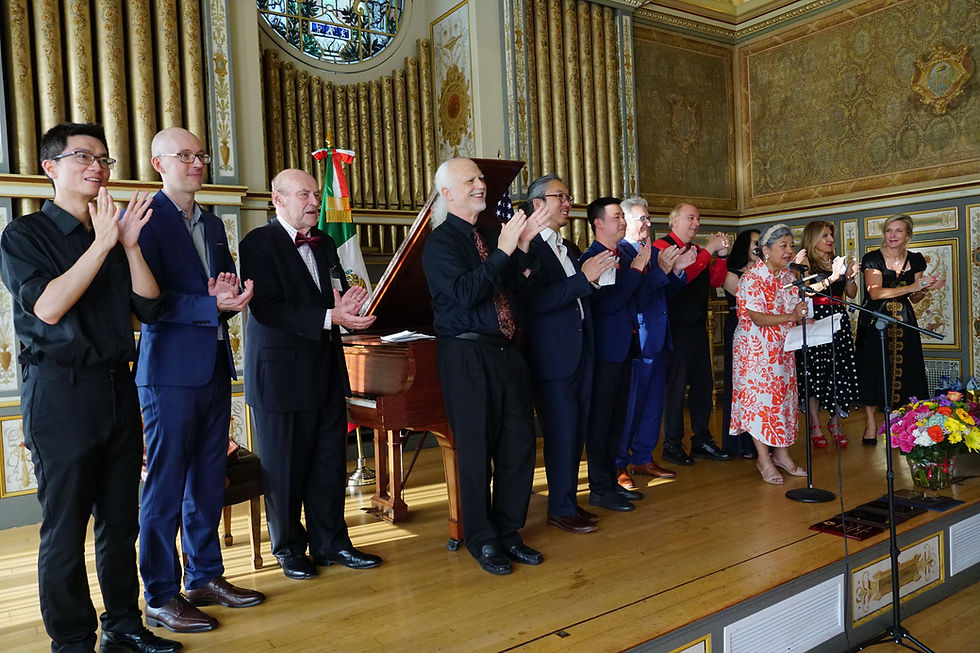
It takes a special occasion to bring an audience together to listen to four hours of classical piano music, and the finals of the WIPAC 2026 Piano Competition proved to be just such an occasion on Sunday, August 9, at the Mexican Cultural Center in Washington, DC.
A dedicated audience gathered once again to hear the final six competitors, who had spent the week advancing through the competition and arrived prepared to perform for the top prizes.
A Celebration of Artistic Commitment
In his welcoming remarks, Mexican Ambassador Juan Carlos Lara Armienta graciously referred to the audience as “La Résistance.” In an era increasingly shaped by artificial intelligence and other high-tech inventions, his remarks underscored the importance of authentic artistic creativity and the human spirit behind it, adding, “Music is the backbone of our civilization.”

The beauty and welcoming spirit of the Mexican Cultural Center provided the perfect setting for the finals of the WIPAC competition, which distinguishes itself for its support for pianists over the age of 32, many of whom pursue demanding careers outside music while continuing to cultivate exceptional artistry at the piano.
The Chairs of this year’s competition were Mark Stubis and Qin Sun Stubis.
Prize Winners and Memorable Performances

This year’s first prize was awarded to Dr. James Chou, whose magnificent performance of Chopin’s Sonata No. 3 in B minor Opus 58 reached for the sublime. Dr. Chou is also a second-year cardiology fellow at Columbia University, making his achievement all the more remarkable.
This mystical composition is considered one of Chopin’s most mature works, written in 1844 in Nohant, France, the home of his companion Georges Sand with whom Chopin enjoyed a long and renowned relationship.
Writer Oscar Wilde, who regarded music as the perfect art form expressing human

emotions with more impact than words, referred to the Chopin Sonata, “I feel that I had been weeping over sins that I had never committed and mourning over tragedies that were not my own.”

And indeed, this was the longing and deep tender yearning that James Chou communicated in his interpretation of the Largo, leaving the final notes seeming to suspend time itself.
Chou’s technical command was evident in the exciting Finale, as his fingers moved effortlessly across the keyboard.
Second prize winner, engineering manager Ivan Wong of Canada, lived up to his own words when he described music as his lifelong companion, performing as one with piano. His performance was distinguished by the beautifully clear and distinct voices that he brought out in the fugue section of the Sonata Ballade, Op 27 by N. Medtner.
Phillip Hosford, the co-director of the Academy of Fine Arts in Gaitherbursg, was awarded the third prize, following his ambitious selection of works by Debussy, Chopin and Liszt. In Liszt’s Ballade No. 2, Hosford explored the vivid colors, dramatic contrasts and rich textures of the work with great virtuosity. The passionate ending of the piece left the audience in great awe.
Semi-finalist Dr. William Bloomquist stunned his audience with the Aaron Copeland Piano Variations. Written in 1930, the work is a dramatic atonal set of variations composed in Copeland’s younger days, prior to his famous melodic symphonic works that made him the personification of the “American Composer.” Performing a work that has been described by Copeland’s best friend, Leonard Berstein, “as “hard as nails,” Bloomquist took on the challenge and conquered its technical challenges with great energy and skill.
Illya Bunyakin, originally from Donetsk, Ukraine, and now residing in Maryland, gave a brilliant performance of Schumann's Symphonic Études en forme de variations, Op. 13 (1852). Particularly memorable was his interpretation of the final variation, which he infused with a jubilant and triumphant spirit.
The work's history added another poignant dimension to his performance. Bunyakin performed the second edition of the Symphonic Études, the version famously performed by the great British pianist Dame Myra Hess during the Blitz of London in World War II. Hess gave approximately 1,500 lunchtime concerts at London's National Gallery during the bombings, providing Londoners and soldiers with a refuge of music amid the devastation of war.
In light of the continuing conflict in Ukraine, the historical resonance was especially moving. Bunyakin's triumphant reading of the final variation seemed to embody the enduring power of music to offer courage, hope, and a sense of humanity even in the darkest circumstances.
Amongst the works performed by the semi-finalist Jonathan Shih, a product designer from Seattle, Washington, was American composer Charles Tomlinson Griffes’ The Fountain of the Acqua Paola, Op 7, No. 3. Shih’s exquisite touch clearly conveyed the imagery of the flowing water of the famous fountain. With the rippling arpeggios the pianist captured the true spirit of this American impressionist masterpiece.
All of the contestants during the 5 day WIPAC Competition deserve congratulations for their extraordinary achievement, discipline, and humanism, as well as for sustaining their talent and love of the piano alongside other demanding pursuits.
Acknowledging the Support Behind WIPAC
Much praise is also due to the generous donors who helped make WIPAC possible. Mark Stubis and Qin Sun Stubis contributed the first prize; Michela Gorham contributed the second prize; and Judith Ramage contributed the third prize. Finalist prizes were awarded by Michael and Portia Davidson.
Additional donors included Dr. Zidi Berger, Mike and Faye Rokni, Suzanne Eisinger, Lisa McFarren-Polgar, Wanda O’Brien, Susanne Tolstoy, Sheila Switzer, Priscilla Huffman, Annie Totah, Diane Merriam, Jeanne Blackwell, Dr. Wayne and Linda Sharp and Lola Reinsch.
And of course, accolades are due to Faye Rokni President of WIPAC, and especially to the “Doyenne” of WIPAC founder Chateau Gardecki and Doyen John Gardecki, whose charisma, vision, and enduring commitment to music has helped make WIPAC possible and allowed it to flourish for more than a quarter of a century. Their legacy is reflected not only in the competition itself, but in the community of musicians and supporters they have nurtured over the years.
It is also the dedication of the jurors that has made WIPAC so successful and respected internationally year-after-year. The distinguished jurors included Prof. Teodora Adzharova, Prof. Frank Conlon, pianist Anna Ouspenskaya, pianist David Witten, Prof. Frederic Chiu and pianist Eric Himy. Deliberations of the Jury were coordinated by the Chair, Michael Davidson. Henri Polgar and Jan DuPlain served as the Press Jury.

Recognizing the immense contribution as a juror of the WIPAC Competition over many years, as well as his remarkable career as a pianist and educator, WIPAC presented an award to Dr. Raymond Jackson.


Comments