
A Celebration of Harmony: WIPAC’s Annual Gala Honors Music, Community, and the Artistry of Michael Slavin
Updated: Dec 22, 2025

In a world too often marked by turmoil, the Washington International Piano Arts Competition’s annual gala once again affirmed the enduring power of music—its ability to uplift, connect, and remind us of the beauty still present in life. Through the artistry of pianist Michael Slavin and the dedication of the WIPAC community, this year’s Gala stood as a testament to harmony not only in sound, but in spirit.
This year’s event once again welcomed the “doyen” of WIPAC pianists, Dr. Michael Slavin, recipient of the Winners Classic Circle 2025. Slavin performed a short recital for an audience composed of long-time supporters, aficionados of piano artistry, and enthusiastic newcomers.

Before an elegant dinner at The Tavern, a historic Georgetown landmark that has hosted luminaries since the American Revolutionary War, guests were introduced to this year’s Gala Committee Co-Chairs, Mark Stubis and his wife, author Qin Sun Stubis. In his welcoming remarks, Mr. Stubis introduced Dr. Slavin, who in turn paid tribute to WIPAC founders Chateau and John Gardecki, whose tireless work over the past quarter-century has elevated WIPAC into one of the world’s most prestigious competitions for the “musical amateur” pianist.
Slavin’s recital featured works by Leoš Janáček, Brahms, Chopin, and Liszt.
A Program of Depth and Emotion
Slavin opened with Janáček’s In the Mists, a work of haunting beauty. In the festive atmosphere of the evening, pianist Slavin’s mastery of the piano and sensitivity for Janáček’s distinctive melodic palette—shaped by Moravian folk influences and the composer’s turbulent emotional world—was vividly realized. Slavin embodied Janáček’s own words: “The art of dramatic writing is to compose a melodic curve that will, as if by magic, reveal immediately a human being in one phase of his life.” As Dr. Slavin so well conveyed on the piano, Janacek’s turbulent life gave form to this work, from melodious phrasing to dramatic tones.

Slavin next performed Brahms’s Rhapsody in B Minor, delivering a powerful, crisp, and deeply dramatic interpretation. Dedicated to Brahms’s close friend Elisabeth von Herzogenberg, a gifted composer and pianist constrained by the conventions of her aristocratic life, the piece resonates with personal warmth. In Slavin’s hands, it recalled her own words to Brahms: “Your music forms an integral part of our lives… like the air and light and warmth.”
Chopin’s Nocturne Op. 27 No. 2, one of his most beloved works, followed. Slavin played with crystalline delicacy and introspective grace, drawing from Chateau Gardecki a spontaneous and heartfelt, “Bravo, Michael!” Composed in 1835, the nocturne was famously performed by Chopin in Leipzig at the home of Friedrich Wieck, for Robert and Clara Schumann and Felix Mendelssohn, who later remarked: “I heard a lovely new notturno by Chopin, a considerable part of which I learned by ear.” Slavin’s performance is a reminder of the importance of preserving such memories and musical traditions.
His finale, Liszt’s Hungarian Rhapsody No. 13, brought virtuosic flair and elegance. Often mistakenly associated with themes from the Spanish violinist Pablo de Sarasate or misattributed to Romani origins, the work actually draws from authentic Hungarian folk melodies. Slavin’s rendition—performed on a legendary Viennese Bösendorfer piano—was poised, exuberant, and commanding.
Honoring a Community of Supporters
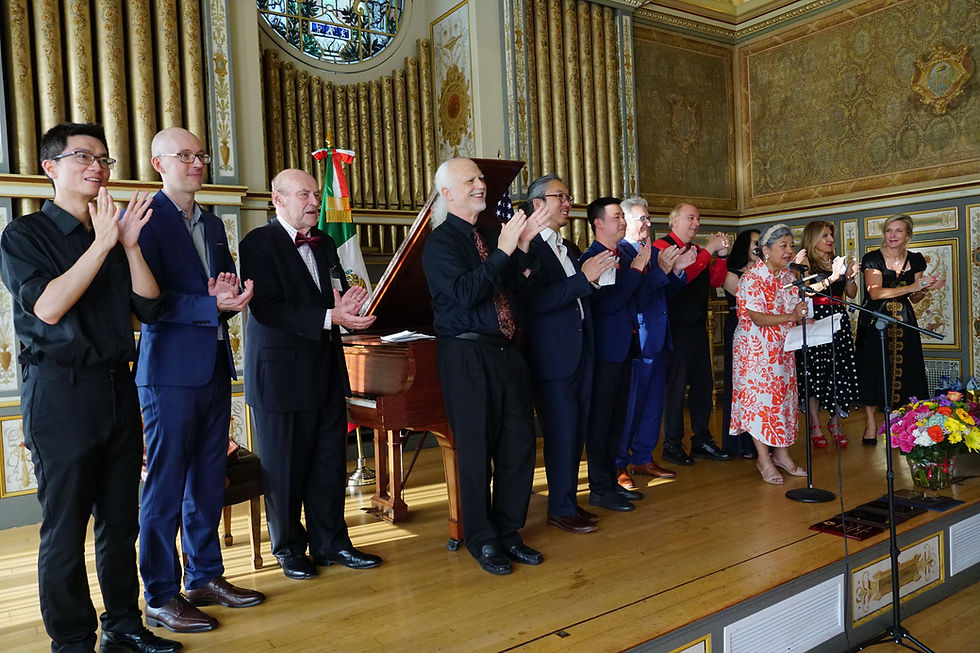
The evening also recognized many individuals whose dedication strengthens WIPAC’s mission. Among them were: Carolyn Fuller, stepping down as President of WIPAC, Faye Rokni, the newly appointed WIPAC President, Portia Davidson, former WIPAC President, Michael Davidson, former President and current Chairman of the Jury, Rhoda Septilici, diplomatic liaison, Michaela Gorham, of the Gorham Family Foundation, Art patrons Wayne and Linda Sharp who generously funded the use of the Bosendorfer piano, and of course, WIPAC founders John and Chateau Gardecki


Comments